
Overview
Circumcision Specialist Clinic in Dandenong offers circumcision for babies and adults, led by an experienced, surgically trained doctor. It is a small, highly specialised practice in a field where people search carefully and privately before they book. Parents want to know a procedure is safe for their baby. Adults want clear, discreet answers before they pick up the phone.
The clinic needed to be found by those people across Melbourne’s south-east, and to give them content they could trust once they arrived.
The challenge
A sensitive, highly specific search
Most people looking for circumcision are not browsing. They search for a specific procedure, an age group or a suburb, and they read closely before deciding. That meant every page had to be medically accurate, reassuring and easy to understand, and it had to answer the questions people are often too embarrassed to ask.
Reaching patients beyond one suburb
Patients travel to a specialist clinic, so ranking for “Dandenong” alone was never going to be enough. The clinic needed to appear for searches from the surrounding suburbs too, without creating thin, repetitive pages.
Competing with large health websites
Hospitals, government health sites and large medical networks take up much of the first page for health topics. A single-location clinic had to earn its place with content that was more useful and more specific than theirs.
What we did
Location pages that answer real questions
We built location pages for the suburbs the clinic’s patients actually come from, including Doveton, Endeavour Hills, Hallam, Hampton Park and Noble Park North, so it could show up for local searches across the south-east. Each page was written for that audience, and we later added FAQ sections answering the questions parents and adult patients ask most often.
Medically accurate, patient-friendly content
We planned the content around the procedures people search for: circumcision for babies and for adults, plus related conditions and aftercare. Every new piece went to the clinic for review and approval before it was published, so it stayed clinically accurate and in the clinic’s voice. We also rewrote and re-optimised existing pages, including the adult circumcision page, to target the terms patients really use.
Keyword research and on-page optimisation
We researched the terms patients use at each stage, from early questions to ready-to-book searches. We used that to sharpen titles, headings and page structure, and to plan new pages where the clinic had no content yet.
Authority and reputation
We set out a backlink strategy to build the clinic’s authority with relevant health and local websites. We also helped with reviews, from encouraging happy patients to share their experience to responding properly when a negative review came in.
The results
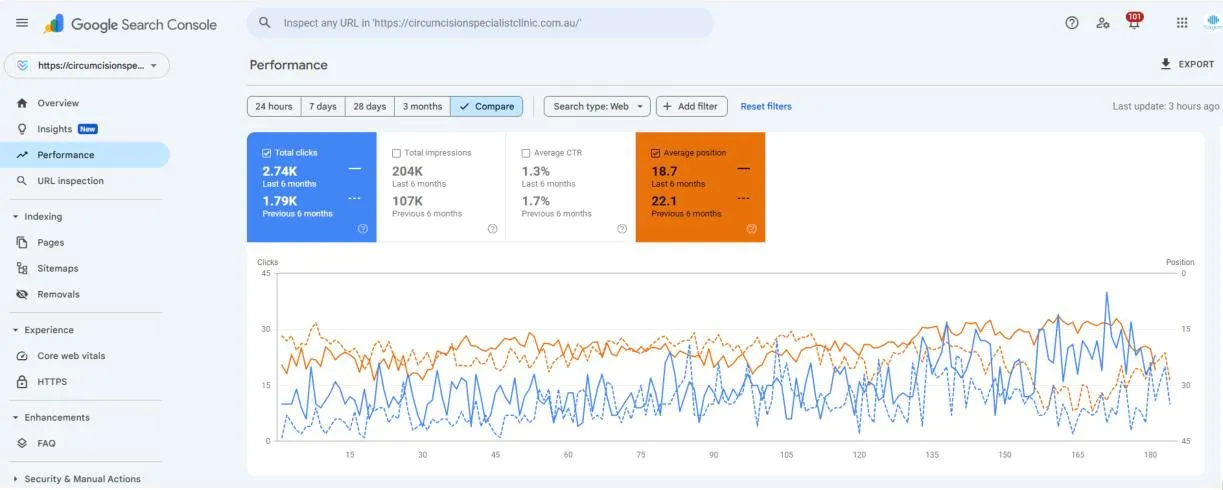
- Total clicks: 2,740 clicks in the six months to August 2025, a 53% increase on the previous period’s 1,790
- Impressions: 204,000 impressions, up 91% from 107,000, so the clinic was showing up in almost twice as many searches
- Search position: average position improved from 22.1 to 18.7
- Click-through rate: CTR moved from 1.7% to 1.3%. With impressions nearly doubling, the clinic was appearing for many more broad searches, which naturally lowers the average CTR even as total clicks rise
Beyond the numbers
- Steady growth through 2024: in Google Analytics, organic visits grew from roughly 70 a month in January 2024 to around 500 a month by October and November, about seven times higher
- Results that last: the six-month comparison above was taken in August 2025, after our main project had wrapped up, and the content we built kept attracting more searches and clicks
- Content patients can trust: every page was reviewed by the clinic, so patients get clear, accurate answers before they book
Conclusion
Specialist medical clinics don’t need a huge website to win on Google. They need the right pages for the right people. By pairing location pages with careful, clinic-approved content and steady on-page work, we helped Circumcision Specialist Clinic reach families and adult patients across Melbourne’s south-east, and the results kept growing after the project ended.